

When planning office partitions, most people decide where the walls go first and choose the doors last.
Yet the way a door opens directly affects usable floor area, furniture layout, circulation and acoustic performance, and it shapes how people experience a meeting room every day. In small meeting rooms, executive offices, focus rooms or high-density offices, which way a door opens and how much space it takes once open often matter more than expected.
There is no single best glass door for an office. The real question is what the space needs most: acoustic separation, floor efficiency, openness or flexibility. Below, we look at four common door types (hinged, sliding, pocket sliding and bi-fold) and where each one works best.
01 | Hinged and Pivot Glass Doors: Acoustics and Privacy First
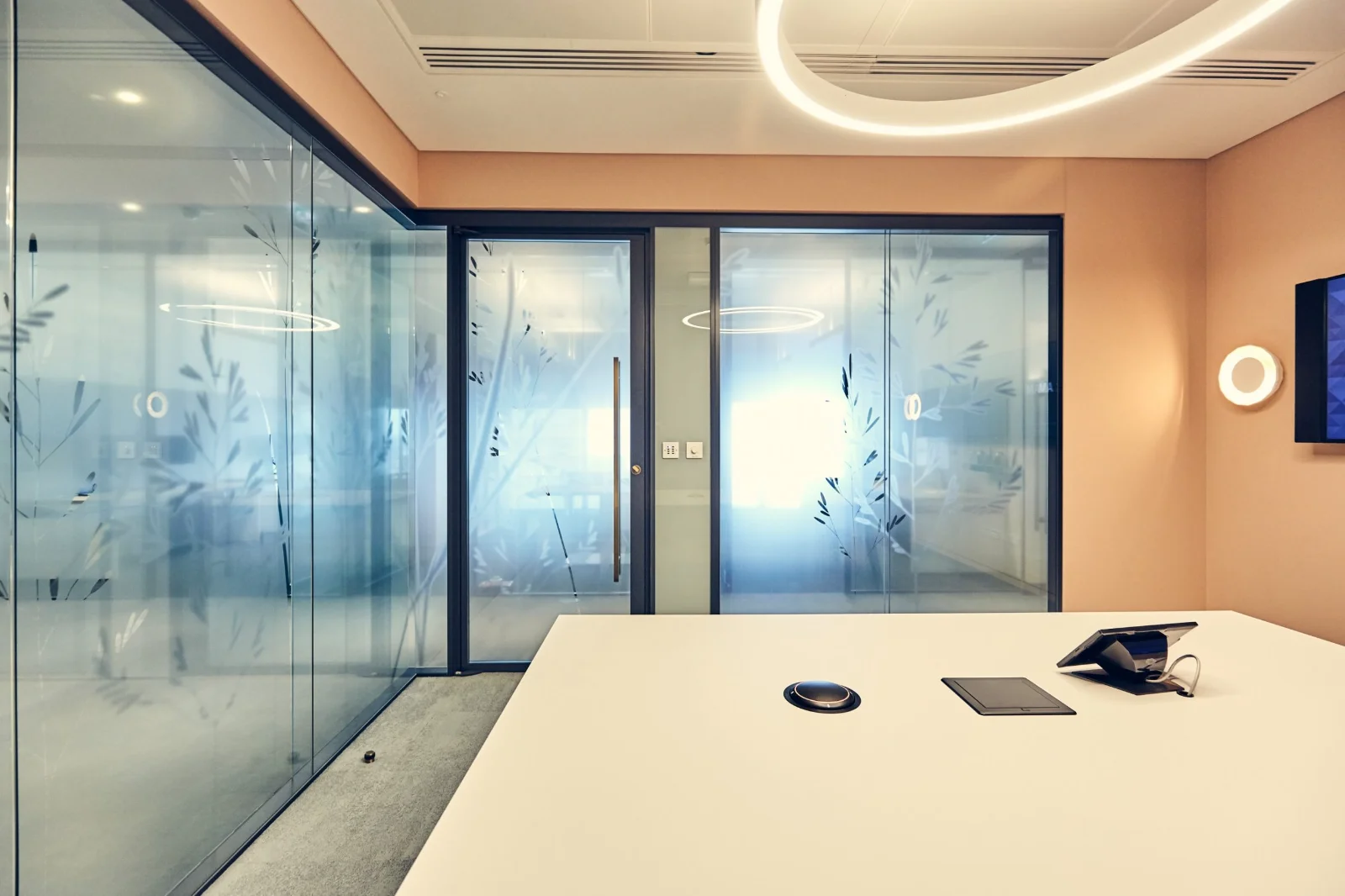
For boardrooms, key meeting rooms, executive offices or any space that needs a higher level of acoustic privacy, a hinged or pivot acoustic glass door is usually the first choice. Once closed, its full frame, perimeter seals and drop seal create a complete acoustic boundary.
The Optima Elite Series, designed for Revolution 100 double-glazed partitions, has been tested in a UKAS-accredited laboratory:
- Elite Symmetry | Rw 43 dB
- Elite Affinity | Rw 45 dB
The Elite Affinity frame can integrate locking hardware, which suits spaces with higher demands for meeting privacy and access control. These doors deliver strong acoustic performance and intuitive use while keeping the natural light and transparency of a glass partition. The trade-off is that the door needs its full swing area, so the layout must leave room for it.
Best for: boardrooms, executive offices, key meeting rooms and any space that needs a higher level of acoustic privacy.
02 | Sliding Doors: Giving the Floor Space Back
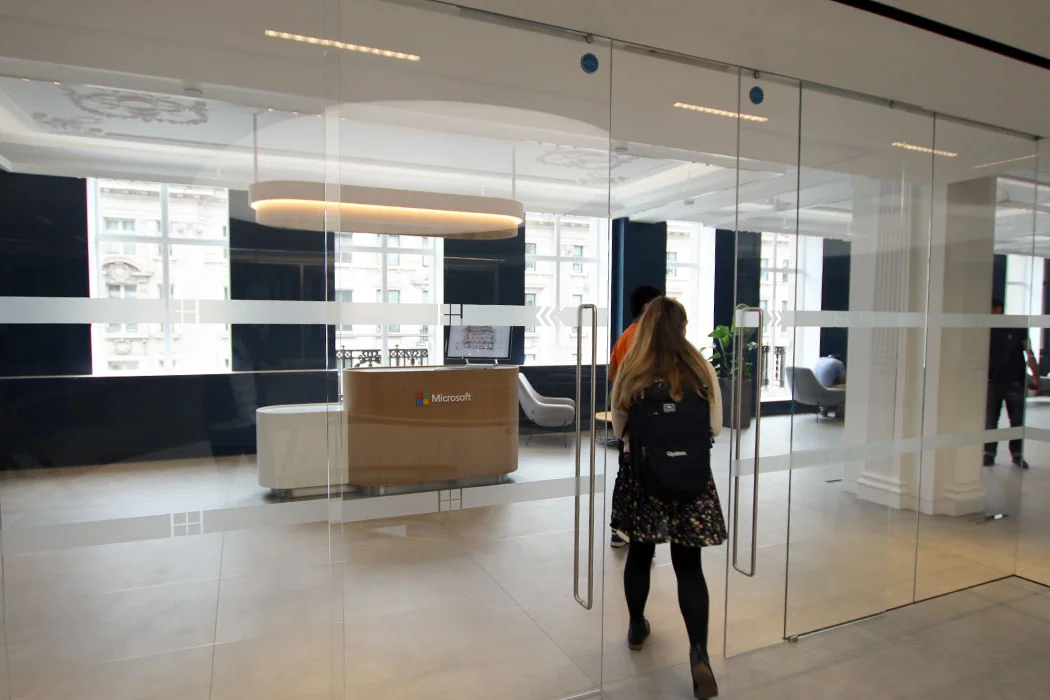
Where floor area is limited, the swing of a hinged door can eat into seating, furniture or circulation. A sliding door is the more efficient choice.
The Optima Kinetic Series is a range of sliding doors designed for Optima 117 Plus single-glazed partitions. The leaf travels horizontally along the wall instead of swinging in or out. The four options are graded by seal level, from the lowest acoustic performance to the highest:
- Kinetic Lite: a frameless leaf focused on transparency and saving space, not intended for acoustic separation
- Kinetic Seal | up to Rw 24 dB: a frameless leaf with edge seals, for spaces that need basic sound separation
- Kinetic Aero | up to Rw 35 dB: a fully framed leaf with the lock built into the frame, balancing acoustics and access control
- Kinetic Align | up to Rw 36 dB: a fully framed leaf with acoustic seals on all four sides, the best-performing configuration in the Kinetic range
For designers, the real constraint a sliding door removes is that furniture and circulation no longer have to work around a swinging door.
Best for: standard meeting rooms, small offices, creative studios, tight circulation and offices that need to make more of every square metre.
03 | Pocket Sliding Doors: Even the Leaf Disappears into the Wall
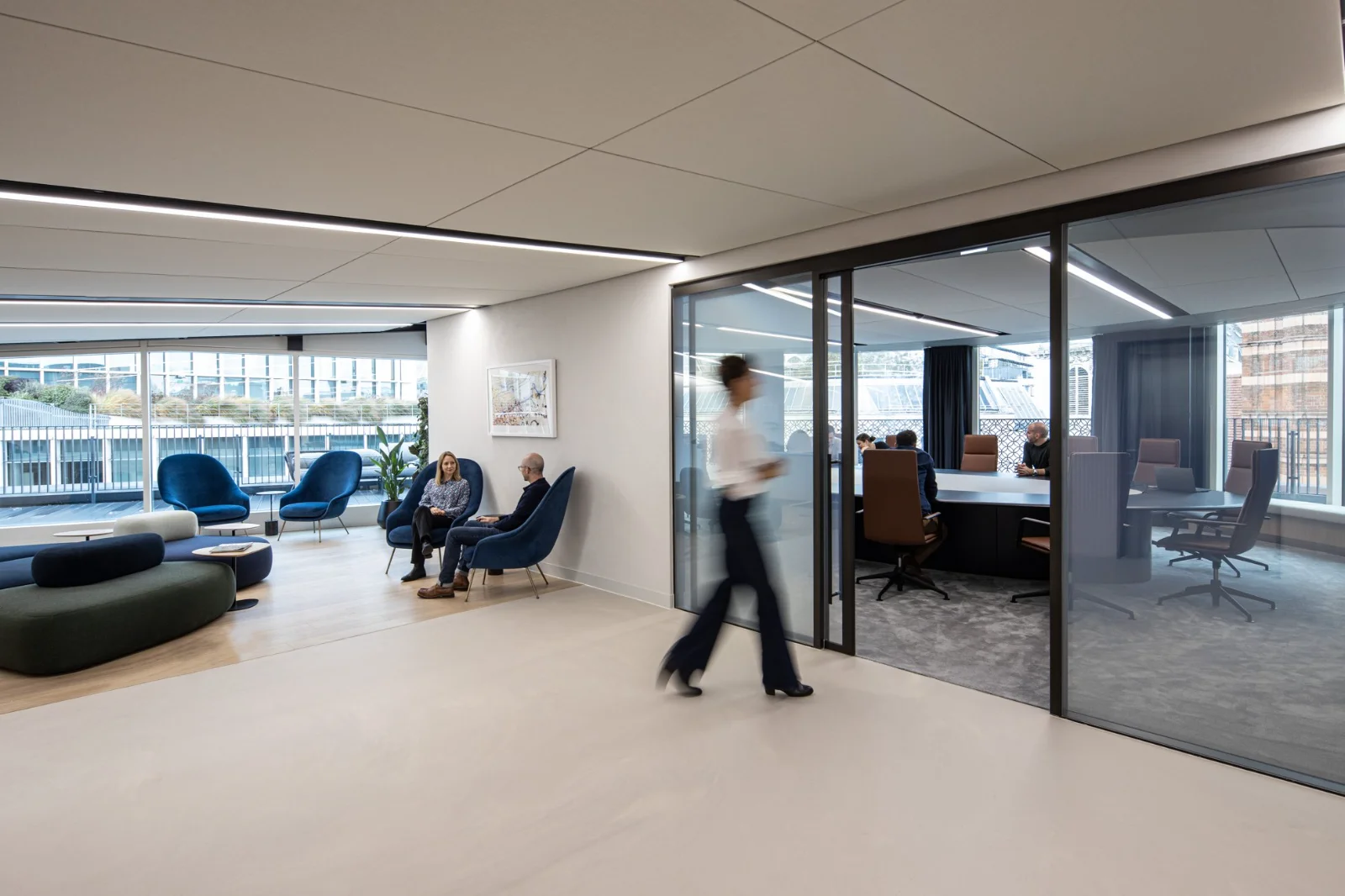
A standard sliding door has no swing, but once open, the leaf still sits alongside the wall. A pocket sliding door goes one step further and slides the leaf into the partition system itself.
Optima Elite Aero PSD is an acoustic pocket sliding door developed for Revolution 100. When opened, the leaf slides between the two panes of the double-glazed partition, with no swing radius and no leaf left parked against the wall.
Elite Aero achieves up to Rw 39 dB, so space efficiency, daylight and acoustic performance all hold together.
The Elite Aero doors Applied Spaces supplies in Taiwan come with a built-in soft-close mechanism that slows the leaf smoothly as it closes, preventing the sound of a door striking its frame and keeping busy meeting rooms quiet.
For small spaces, the value of a pocket door is that it all but disappears from the floor plan.
Best for: small meeting rooms, focus rooms, executive offices, creative studios and any office where every square metre has to work.
04 | Bi-Fold Glass Doors: When You Need a Wide Opening
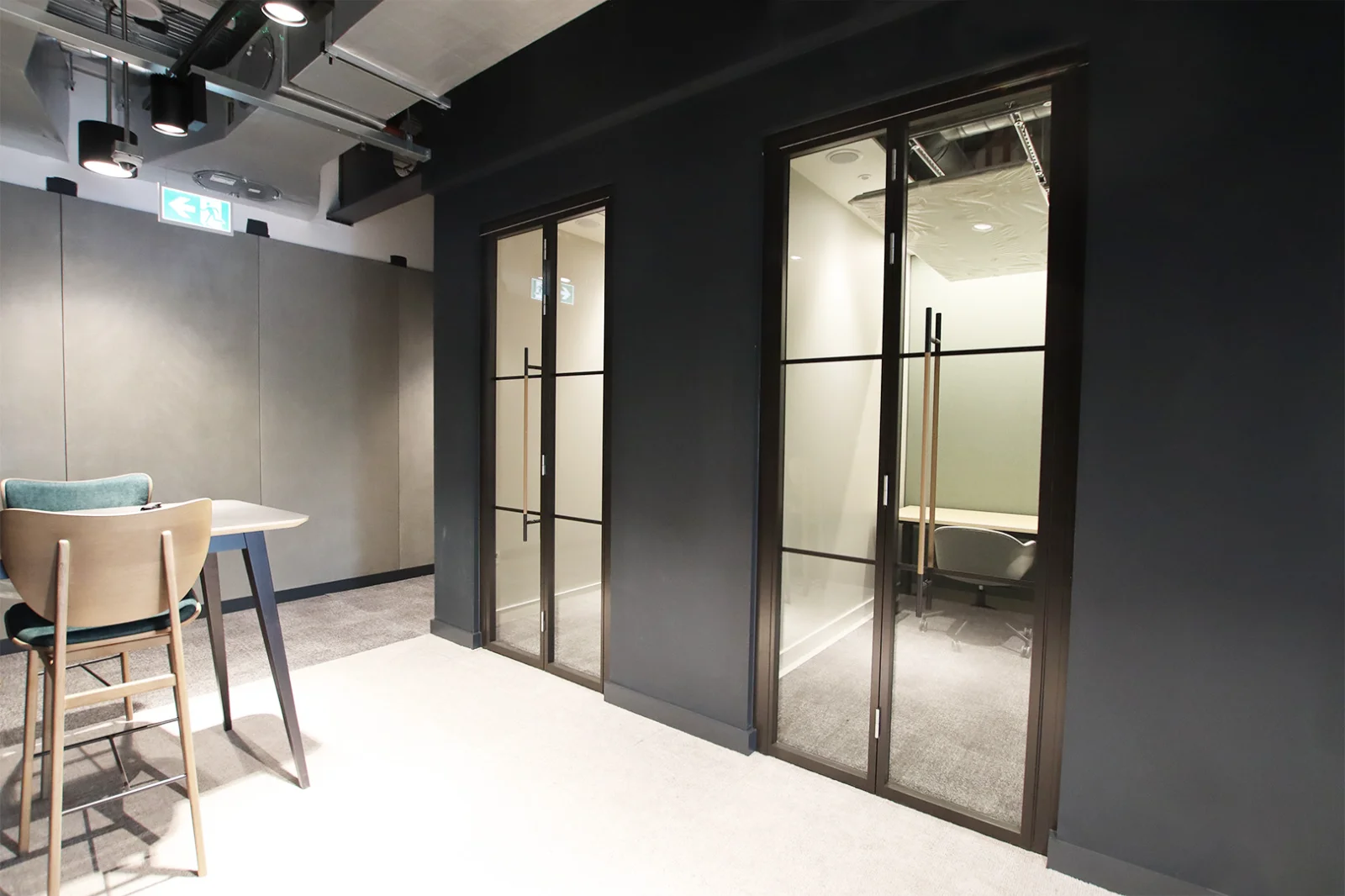
A bi-fold door takes a third route. Its leaves fold back on themselves, so opening the door does not require a full swing area, and when closed it still forms a complete glass boundary. Optima Edge Bi-Fold is a single-glazed folding door with acoustic performance of up to Rw 33 dB.
Best for: flexible areas that need a wide opening while keeping daylight through the glass, such as meeting rooms that open up or multi-purpose spaces. It remains a relatively uncommon choice in Taiwan offices.
Four Office Glass Doors Compared
| Door type | Representative products | Space required | Acoustic performance | Best for |
|---|---|---|---|---|
| Hinged / pivot | Elite Symmetry / Elite Affinity | Needs a full swing area | Rw 43 to 45 dB | Boardrooms, executive offices, key meeting rooms |
| Sliding | Kinetic Lite / Seal / Aero / Align | Low; the leaf travels along the wall | Rw 24 to 36 dB | Standard meeting rooms, small offices, creative studios |
| Pocket sliding | Elite Aero PSD | Very low; the leaf retracts into the wall | Rw 39 dB | Focus rooms, small meeting rooms, executive offices |
| Bi-fold | Edge Bi-Fold | Low to medium; the leaves fold back | Up to Rw 33 dB | Meeting rooms, flexible spaces |
Figures above are the maximum acoustic ratings published by Optima. Optima products are independently acoustically tested in UKAS-accredited laboratories in the UK; actual performance varies with door and glass configuration and site installation.
Three Questions to Choose Your Door
Answer these three before you draw the floor plan, and the door type usually follows.
Q1 How quiet does the room need to be?
- Conversations about pay, legal matters or board-level decisions → hinged or pivot door (Rw 43 to 45 dB)
- General meetings that should not be disturbed by corridors or neighbouring rooms → pocket sliding door or fully framed sliding door (Rw 36 to 39 dB)
- Visual separation only, with sound not a priority → frameless sliding door (Kinetic Lite)
Q2 What will the door get in the way of when it opens?
- Nothing, and the corridor is wide enough → a hinged door is the most intuitive and the easiest to keep on budget
- Seating, storage or circulation → a sliding door, with the leaf travelling along the wall
- Even the wall is needed for furniture, whiteboards or equipment → a pocket sliding door, with the leaf retracting into the wall
Q3 Will this layout change again?
- Likely to be reconfigured within one to two years → choose a dry-jointed system partition, so doors and partitions can be taken down and reused together
- Fixed for the long term → let the first two answers decide the door type, and focus the budget on acoustic rating and hardware
Choose Your Doors Early in the Fit-Out
An office’s acoustic performance is not decided by the Rw value of the glass wall alone. The door, frame, seals, the ceiling void above, wall junctions and site installation can each become the deciding factor.
How a door opens also affects seat count, furniture layout, circulation and usable floor area. The later the door type is decided, the less room there is to adjust: change a door after the partition drawings are final, and the walls often have to move with it.
Further reading: How to Choose Office Partitions: Glass, Drywall and Modular Systems Compared, Meeting Room Privacy: Acoustics, Sightlines and Layout, What Drives the Cost of Glass Partitions? Five Factors Behind Every Quote.
FAQ
What types of office glass doors are there?
There are four common types: hinged or pivot doors, sliding doors, pocket sliding doors and bi-fold doors. They differ in how the door opens and where the leaf goes, which directly affects the space it takes and its acoustic performance.
What is the difference between a pocket sliding door and a standard sliding door?
When a standard sliding door opens, the leaf sits alongside the wall. A pocket sliding door slides the leaf into the partition itself, so it takes up no wall space when open. Optima Elite Aero PSD is an acoustic pocket sliding door designed for Revolution 100.
Are sliding doors less soundproof than hinged doors?
Not necessarily. It depends on the seal design. Kinetic Seal is rated Rw 24 dB, Kinetic Align reaches Rw 36 dB and the Elite Aero pocket sliding door reaches Rw 39 dB. For higher acoustic privacy, the Elite Symmetry and Elite Affinity hinged and pivot doors reach Rw 43 to 45 dB.
Which door suits a small office?
Where space is limited, start with a sliding door. If you want the leaf itself to take up no wall space, a pocket sliding door is the most space-efficient option and suits focus rooms, small meeting rooms and executive offices.
Where do these Rw values come from?
They are published by Optima. Optima products are independently acoustically tested in UKAS-accredited laboratories in the UK, and actual performance varies with the overall construction and site installation. At the planning stage, we provide the relevant data and door recommendations for your space.
When should the door type be decided?
Ideally at the partition planning stage. The way a door opens affects corridor width, furniture layout and usable floor area, and by the later stages of a fit-out there is usually little room left to adjust.